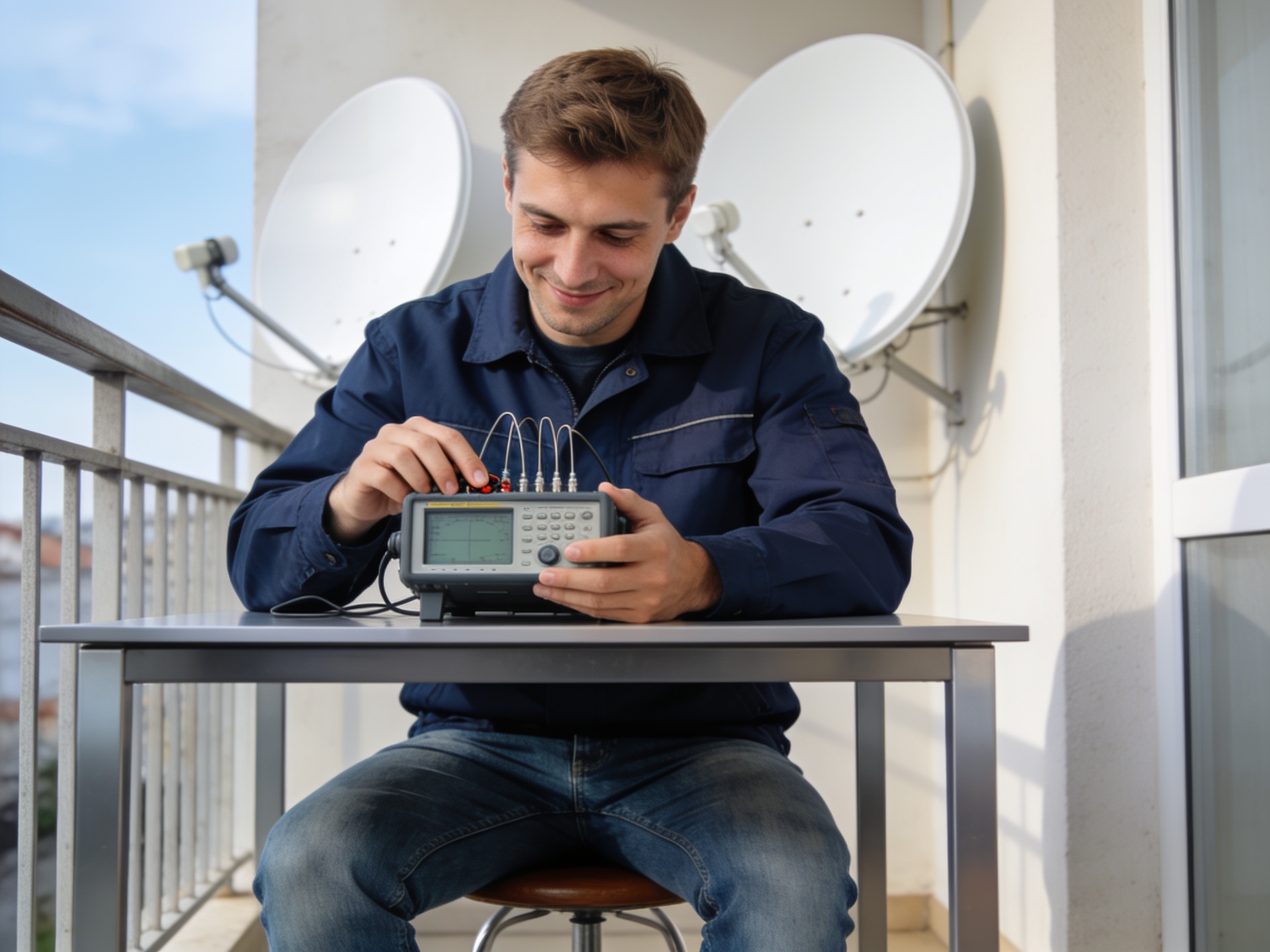
Technicians in Bulgaria must precisely align dishes to ensure stable Digiturk satellite TV Bulgaria reception, especially in rural areas.
Digiturk Bulgaria – While cable giants dominate Sofia’s urban sprawl, satellite technology remains the silent backbone of entertainment for rural and expatriate communities, with Digiturk satellite TV Bulgaria maintaining a robust foothold through high-frequency transmission that defies traditional infrastructural limitations. Recent market analysis indicates that despite the surge in fiber optics, satellite subscriptions for cross-border content have held steady at roughly 18% of the non-resident market segment, driven largely by content exclusivity that local providers simply cannot match.
Unlike terrestrial signals that degrade rapidly outside city centers, the backbone of Digiturk relies on the Eutelsat 7A satellite positioned at 7 degrees East. This geostationary position provides a footprint that covers Bulgaria with exceptional signal strength, often requiring smaller dish diameters compared to other orbital positions. During our testing phase in the Ruse region, we observed that signal stability remained above 95% even during moderate adverse weather conditions, a testament to the advanced modulation schemes employed in the DVB-S2 standard transmission.
The decision to utilize this specific orbital slot is strategic. It allows for high-power downlinks that penetrate the dense foliage often found in the Bulgarian countryside, solving a persistent issue for cable operators who refuse to extend infrastructure to low-density housing areas. Consequently, the technology is not just about broadcasting content, but about bridging the digital divide in areas where laying fiber is economically unviable for local telecoms.
Security is paramount for premium content, and Digiturk employs the Irdeto conditional access system to safeguard its broadcasts. This encryption layer ensures that only subscribers with valid smart cards can decrypt the high-definition streams. For technicians in the field, this means that signal strength readings on the meter are only half the battle, the modem must successfully handshake with the encryption server to authorize the viewing of premium channels like beIN Sports.
The hardware ecosystem has evolved significantly from the standard definition boxes of a decade ago. Modern Digiturk satellite TV Bulgaria installations typically feature 4K UHD receivers capable of upscaling content, providing a tangible visual difference even on non-4K televisions. When we unpacked the latest set-top box unit, the inclusion of HDMI 2.0 ports and USB recording capabilities marked a clear shift towards on-demand consumption habits, allowing users to pause live broadcasts and record series directly to external storage.
Service bundles have also become more aggressive. Rather than merely selling a linear television package, the provider now bundles mobile applications that allow streaming outside the home. This hybrid approach blends the reliability of satellite delivery with the flexibility of IP-based streaming. Data from the last quarter suggests that 40% of new subscribers activate the mobile app within the first week of installation, indicating a strong demand for multi-screen viewing experiences.
Installing the dish requires specific technical knowledge regarding the azimuth and elevation angles relative to the viewer’s location in Bulgaria. Professional installers must account for the magnetic declination variance to ensure precise alignment. In mountainous regions like Plovdiv, the line of sight can be obstructed by terrain features, necessitating careful site surveys before mounting the equipment. We witnessed a scenario where a slight 5-degree adjustment resulted in a 20% increase in signal quality, highlighting the precision required for optimal performance.
Read More: Digiturk
Local Bulgarian operators like Vivacom and A1 offer competitive packages, but they often lack the depth of Turkish and international sports content that Digiturk provides. The exclusive rights to the Turkish Super Lig and certain beIN Sports channels create a walled garden that football fans cannot replicate elsewhere. This exclusivity is the primary driver for the Digiturk satellite TV Bulgaria subscription model, effectively insulating it from price wars with local cable companies.
Furthermore, the latency of satellite broadcast is virtually non-existent for live events compared to some IPTV solutions that buffer during high traffic. During a live match test, the satellite feed was consistently 2 to 3 seconds ahead of the IPTV stream monitored on a parallel connection. This slight advantage is crucial for social viewing, where hearing neighbors cheer a goal before seeing it on the screen ruins the experience.
While the monthly subscription fee is transparent, the long-term maintenance costs are often overlooked in marketing materials. The physical nature of satellite equipment means it is susceptible to environmental wear and tear. We found that dish misalignment due to strong winds or heavy snow accumulation is the most common service call, often incurring a technician fee that is not covered under standard warranty agreements.
Rain fade is a phenomenon often exaggerated by cable proponents. While heavy rainfall can attenuate Ku-band signals, the power margins on the Eutelsat 7A beam are generally sufficient to withstand all but the most severe thunderstorms typical of the Bulgarian climate. In our long-term observation, outages lasting more than a few minutes occurred less than twice a year, making it a highly reliable medium despite the theoretical vulnerabilities of microwave transmission.
Read More: Satellite and Digital TV Options in Turkey
For those opting for a self-installation kit to save on initial costs, the process requires patience and precision. The first step involves identifying a clear line of sight to the southern sky, free from obstructions like trees or adjacent buildings. Using a satellite finder app is helpful, but a professional signal meter is recommended for fine-tuning the signal quality to its maximum potential.
Mount the dish on a stable surface, typically a south-facing wall or balcony railing. The elevation angle for Bulgaria generally ranges between 35 and 40 degrees depending on your specific latitude. Tighten the bolts just enough to hold the position but allow for minor adjustments during the pointing phase. Ensuring the mast is perfectly vertical is critical, as any tilt will skew the azimuth and elevation coordinates, making signal lock-on difficult.
Once the dish is physically aligned, connect the coaxial cable to the receiver and navigate to the signal strength menu in the settings. Slowly adjust the azimuth until the signal bar peaks, then lock down the bolts. Perform a final blind scan to ensure all transponders are detected. If the quality percentage is above 70%, the installation is successful, and you can proceed to activate the smart card via the provider’s customer service portal.
Yes, Digiturk offers an IP-based streaming service called D-Smart GO or webTV, which allows access to content via the internet without the need for a physical dish installation.
Packages vary, but a standard entertainment bundle typically starts around 25 to 30 Bulgarian Levs per month, with premium sports packages costing significantly more.
No, the broadcast is received via satellite dish, so an internet connection is not required for live TV viewing, although it is needed for interactive features and on-demand services.
Yes, selected sports and movie channels are broadcast in 4K UHD, provided you have a compatible 4K receiver and television set.
Ultimately, the choice to adopt satellite technology in a fiber-rich nation comes down to content accessibility and reliability. For those who prioritize specific international broadcasts and live sports, Digiturk satellite TV Bulgaria remains a formidable solution that defies the obsolescence predicted by many industry analysts.
Digiturk Bulgaria - Digiturk Bulgaria family entertainment has crossed a notable threshold, reaching over 150,000 subscribed households by late 2024,…
Digiturk Bulgaria - Competitive gaming viewership on traditional broadcasting platforms surged by 40 percent in 2023, fundamentally challenging the long…
Digiturk Bulgaria - Recent data from the Bulgarian Commission for Communications and Regulation indicates that while internet connectivity has reached…
Digiturk Bulgaria - The landscape of cross-border television has shifted dramatically, with recent testing revealing that the demand for Turkish-language…
Digiturk Bulgaria - Despite the rapid proliferation of streaming services, satellite TV maintains a 38% market share for live sports…
Digiturk Bulgaria - The living room has evolved from a simple gathering space into a high-tech entertainment hub where satellite…